
SNNEC - Sensors with neural networks-based edge computing
The availability of low-power microcontrollers with embedded neural network accelerators enables the design of entirely new types of sensors that use intensive computational processing at the sensing point, so-called edge processing. The implementation of local processing using neural networks is advantageous in high-dimensional and nonlinear problems.
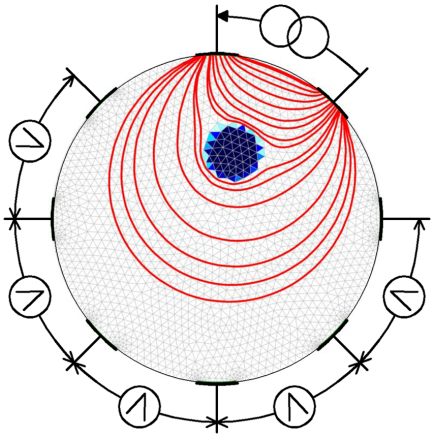
One example is solving the inverse problem in Electrical Resistance Tomography (ERT) directly at the sensing electrodes. Sensors using ERT help monitor flows and processes inside vessels and pipelines in the industry, enable the monitoring of structures' health, and allow specific imaging and diagnosis in medicine.
Electrical Resistance Tomography (ERT) is a relatively new method in the field of structural health monitoring. ERT is a non-intrusive invasive method enabling mapping of the spatial representation of the electrical conductivity of the monitored object on the basis of measuring the electrical voltage on its boundaries that appear due to the flowing current. It is, therefore, obvious that the measured object must be sufficiently conductive to allow safe electrical voltage to excite sufficient electrical current.
Past research in our group shows promising results in the area of Structure Health Monitoring for aerospace. An electrical conductivity of carbon fibers and percolation conductivity of carbon nanotubes are those materials suitable for resistance tomography usability allowing to use it in-situ. As well it is evident, that resistance tomography is able to visualize those defects, which affect the electrical conductivity of the material. Impact detection and assessment, delamination propagation, and debonding detection fall into the area of defects, which are affecting the electrical conductivity and therefore theoretically detectable by the ERT.
Another group of applications studied in SNNEC is local-type recognition of complex signals using a large number of features.
Another application area is local anomaly detection in monitored signals for machine condition monitoring and predictive maintenance. Local anomaly detection not only allows for the early identification of abnormal patterns or deviations in monitored signals but also enables precise issue localization. By focusing on local anomalies, maintenance teams can quickly pinpoint specific areas or components within a machine exhibiting irregular behavior, reducing downtime.
Postdoctoral position available:
The main focus of the research will be modeling and developing neural networks that can be implemented in constrained sensor hardware to address the above topics, constructing sensor prototypes, and evaluating performance in real-world applications. Collaboration with other lab members responsible for the frontend parts of the sensors is expected.
Contact mentor for details: smid [at] fel.cvut.cz
Funding & Aplication Form:
https://international.cvut.cz/jobs-at-ctu/postdoc/